My mom once asked me: "How does ChatGPT know so much? Is it actually thinking?"
That question stuck with me. Because the honest answer is both simpler and stranger than most people expect.
So let me show you — starting with a game.
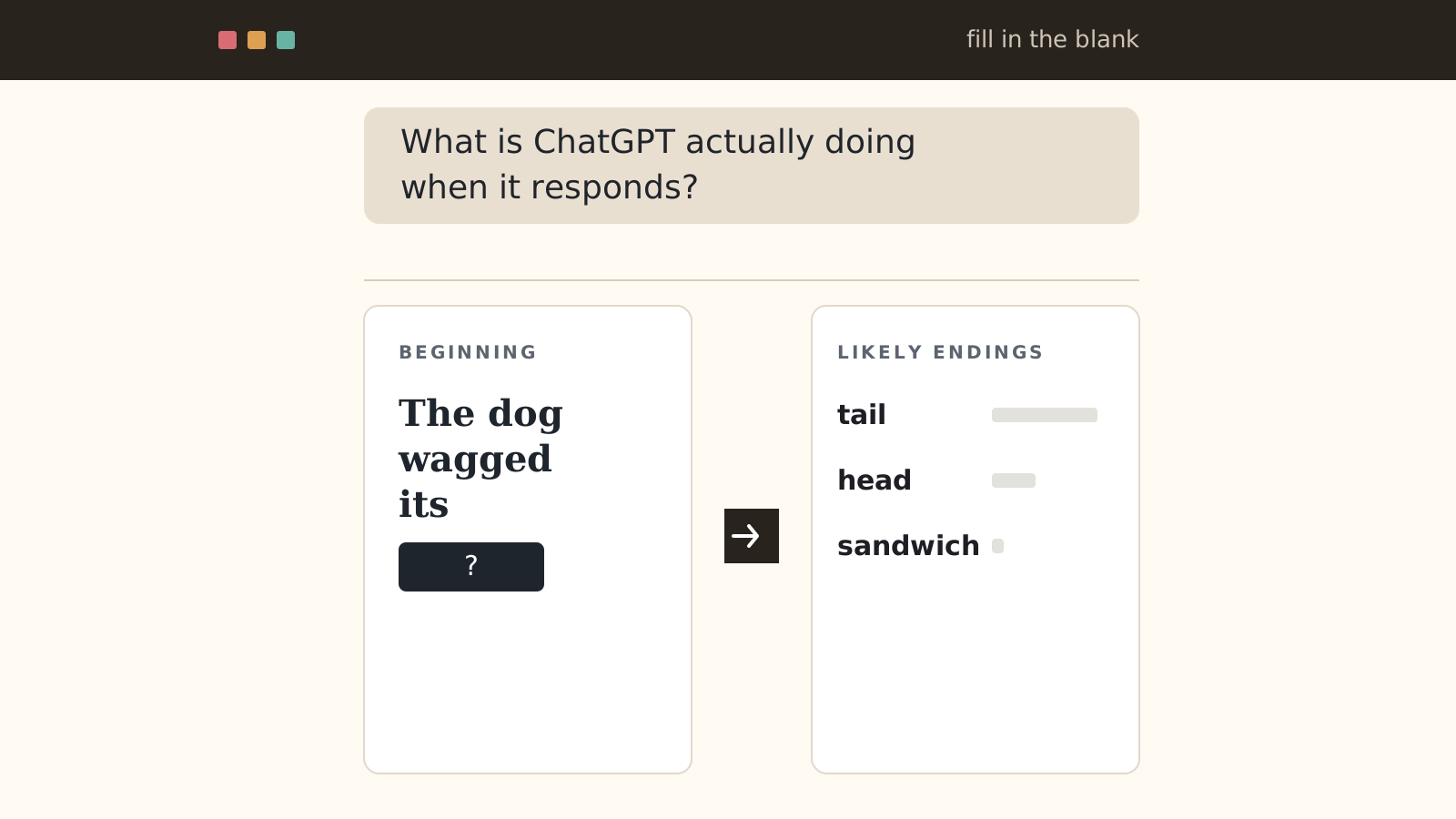
Let's play fill-in-the-blank
Here is the beginning of a sentence. What word do you think comes next?
You probably had a guess before you even clicked anything. "Cry" or "laugh" felt right. "Read" felt wrong.
That instant sense — that feeling of what word belongs — is the entire engine behind ChatGPT.
ChatGPT is doing exactly what you just did. It looks at what came before and picks the most likely word to come next. Then it does it again for the next word. And again. And again — until a full response appears.
That is genuinely it. Not magic. Not a brain. Just the world's most well-practiced fill-in-the-blank player.
How did it get so good at guessing?
Imagine you spent your entire life reading. Every book, every article, every recipe, every news story, every conversation, every user manual — everything ever written.
After all of that, you would have a deep sense of how language works. Not from studying rules. Just from absorbing patterns. You would know that "She opened her birthday present and started to ___" almost never ends with "sleep." You just would.
That is how ChatGPT learned. It read an almost unimaginable amount of text. And every time it guessed wrong, it corrected itself — a tiny bit, millions of times over. The same way a child figures out "I goed to the store" sounds wrong without anyone ever teaching them grammar. Just by hearing enough examples.
After enough of those tiny corrections, it became very, very good.
Nobody programmed it with rules. Nobody told it "when someone opens a gift they might cry." It figured that out on its own — by reading enough human writing to recognize the shape of it.
Wait — it doesn't even read whole words?
Here is where it gets a little surprising.
The AI does not read words the way you do. Instead, it chops language into small pieces — sometimes a full word, sometimes just part of one.
Tap the button to see what the AI does with "unbelievable":
And it works the same way for other words. "ChatGPT" might get sliced into:
Why does it do this? Because patterns are easier to find in small pieces. The chunk "un" shows up in thousands of words — unkind, unusual, unbelievable, unhappy — and from all of those examples the AI learned that it almost always signals the opposite of something. It can apply that pattern anywhere, even in a word it has never seen before.
Think of it like LEGO bricks. You do not need to have built every possible structure to know how bricks fit together.
How does it remember what it's talking about?
Here is the next question you might have. If it is just guessing one piece at a time, how does it stay on topic? How does it know, halfway through a long response, what the original question was about?
The answer is that it does not just look at the piece right before. It looks at everything before — and it has a way of figuring out which earlier pieces matter most for the piece it is guessing right now.
Read this sentence carefully:
She picked up the cup and slowly drank from it.
Tap on "it" to see which word the AI connects it to.
You instantly knew "it" meant the cup, not the table, not her hands, not the room. Your brain tracked back to the right word automatically.
The AI does the same thing — but for every single piece in the response, all at once. It figures out which earlier words are most relevant to the current guess, and leans on those more heavily.
This is the part that makes the AI feel like it is actually following the conversation. Not because it understands in the way you do — but because it has learned to track the connections between words the way a very careful reader would.
So why does it sound like a real person?
Because everything it learned came from real people.
Every explanation it has ever absorbed was written by a human trying to explain something to another human. Every joke, every letter, every argument, every apology, every how-to guide — all of it came from actual people with actual voices.
The AI absorbed all of that. Not by understanding it. By recognizing the patterns of it so thoroughly that it can reproduce them.
Think of a musician who has heard thousands of songs. They can sit down and improvise something that sounds original — not because they invented music, but because they have absorbed so many patterns that putting them together feels natural. The AI does the same thing, but with language.
It is not conscious. It is not thinking about you. It is not feeling anything.
It is pattern-matching at a scale that is genuinely hard to picture — and because those patterns come from humans, the output sounds human too.
But it also learned from human feedback
Reading everything gave it fluency. Fluency alone is not the same as being helpful.
After the initial training, teams of people rated the model's responses. Which answer was clearer? Which was more honest? Which was more useful? The model adjusted based on those ratings — the same tiny-correction process, now aimed at being genuinely worth talking to.
This is the step that turned a very good text predictor into an assistant. It is why ChatGPT tends to follow instructions, tries to be balanced, and sometimes says "I am not sure" instead of just confidently making something up. The underlying model could have written almost anything. The version shaped by human feedback learned to write things people actually found useful.
Reading shaped its voice. Human feedback shaped its judgment.
When it's confidently wrong
Here is where things crack a little, and this part is important to know.
The AI can be completely wrong while sounding completely certain. There is no internal alarm that goes off and says "wait, I'm not sure about this." It just keeps picking the most likely next word — even when the chain of guesses has quietly gone sideways.
It does NOT
- Know when it is making something up — there is no internal alarm
- Actually understand — it pattern-matches, it does not comprehend
- Guarantee accuracy, even when it sounds completely certain
- Browse the web or recall past conversations unless those tools are turned on
It IS great at
- Explaining complex things simply
- Drafting, summarizing, and rewriting
- Thinking through many options quickly
- Working through real constraints and tradeoffs
The most useful habit when using AI: treat its answers as a very good first draft. Check anything that actually matters.
The one-sentence version
If someone asks you to explain ChatGPT at a dinner table, here it is:
ChatGPT learned to guess what word comes next by reading an enormous amount of human writing — and it does that, one piece at a time, until a full answer appears.
Everything else — the fluency, the wit, the occasional confident wrongness — falls out of that one idea, played out at enormous scale.
Not magic. Not a brain. Not something thinking about you.
A very well-read guesser. And somehow, that turns out to be genuinely useful.