
Not sure what I was doing last night. It was late, I was not working on anything in particular, and out of nowhere my brain went: what is time?
Not "what time is it." What is time.
That was the end of my evening. Two hours down a hole that started at time, fell sideways into gravity, and ended somewhere around "space is not actually empty." I came out more confused than when I went in.
So naturally, I am going to try to explain it.
First, space is bigger than it feels
I started with Voyager 1.
Launched in 1977. Still flying. The most distant human-made object, and the fastest spacecraft still traveling outward on an escape trajectory, occasionally phoning home from the dark.[1]
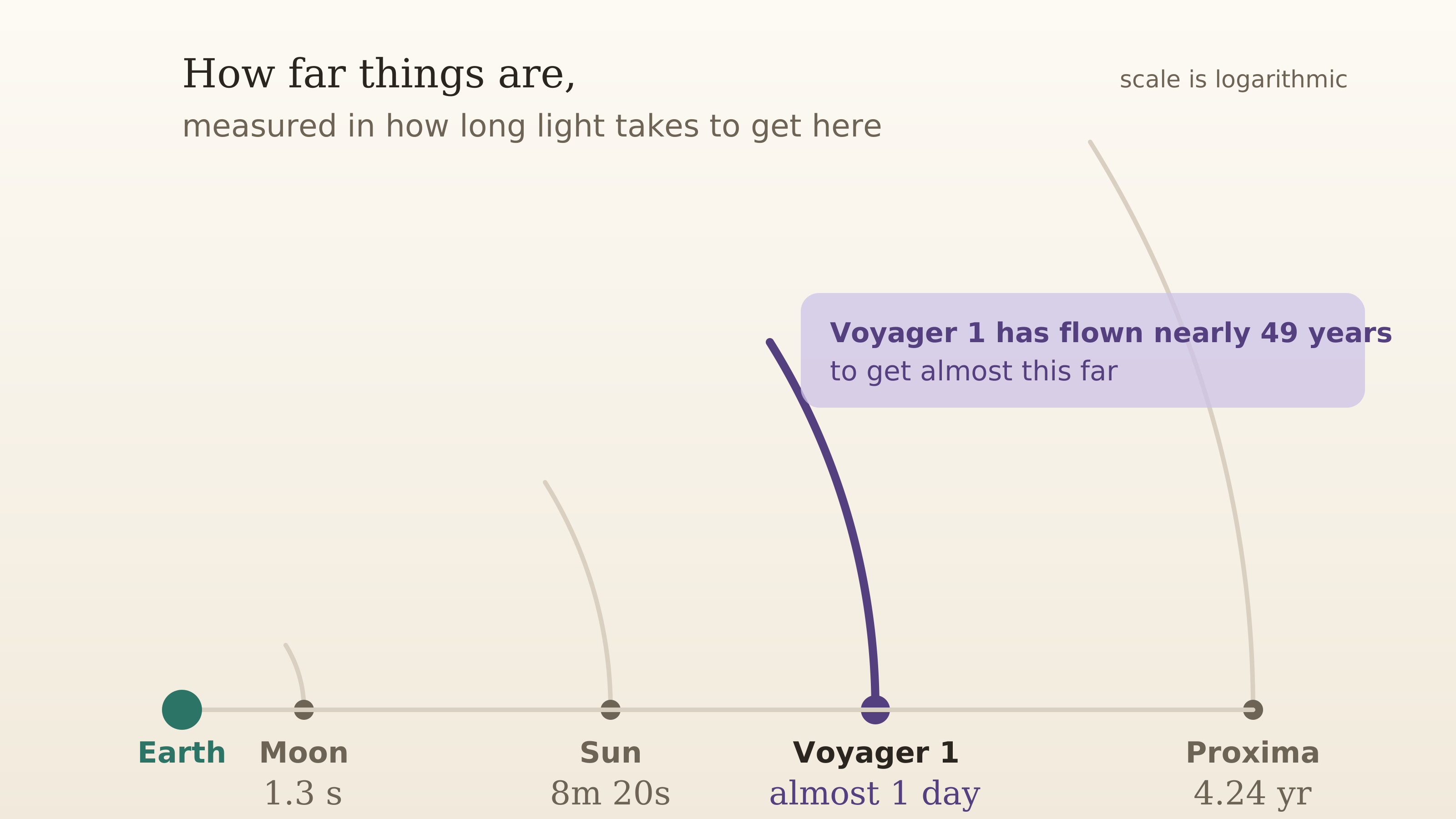
It is almost one light-day away — a milestone it reaches in November 2026.[2]
I had to sit with that one. Nearly forty-nine years of continuous flight, and it has covered almost the distance light crosses in a single day.
A light-day is not "a day of travel." It is how far light gets in 24 hours — about 25.9 billion kilometers. Voyager needed half a century.
And Voyager is still the near end of things. Measured in light:
- Moon to Earth: 1.3 seconds
- Sun to Earth: 8 minutes 20 seconds
- Nearest star: 4.24 years
Four years. At the speed of light. To the nearest one.
That was the first thing that broke for me. Not that space is big — everyone says space is big. It was that our fastest outward traveler, after a lifetime of flying, has not even cleared light's daily commute.
Then "now" stopped making sense
This next part snuck up on me.
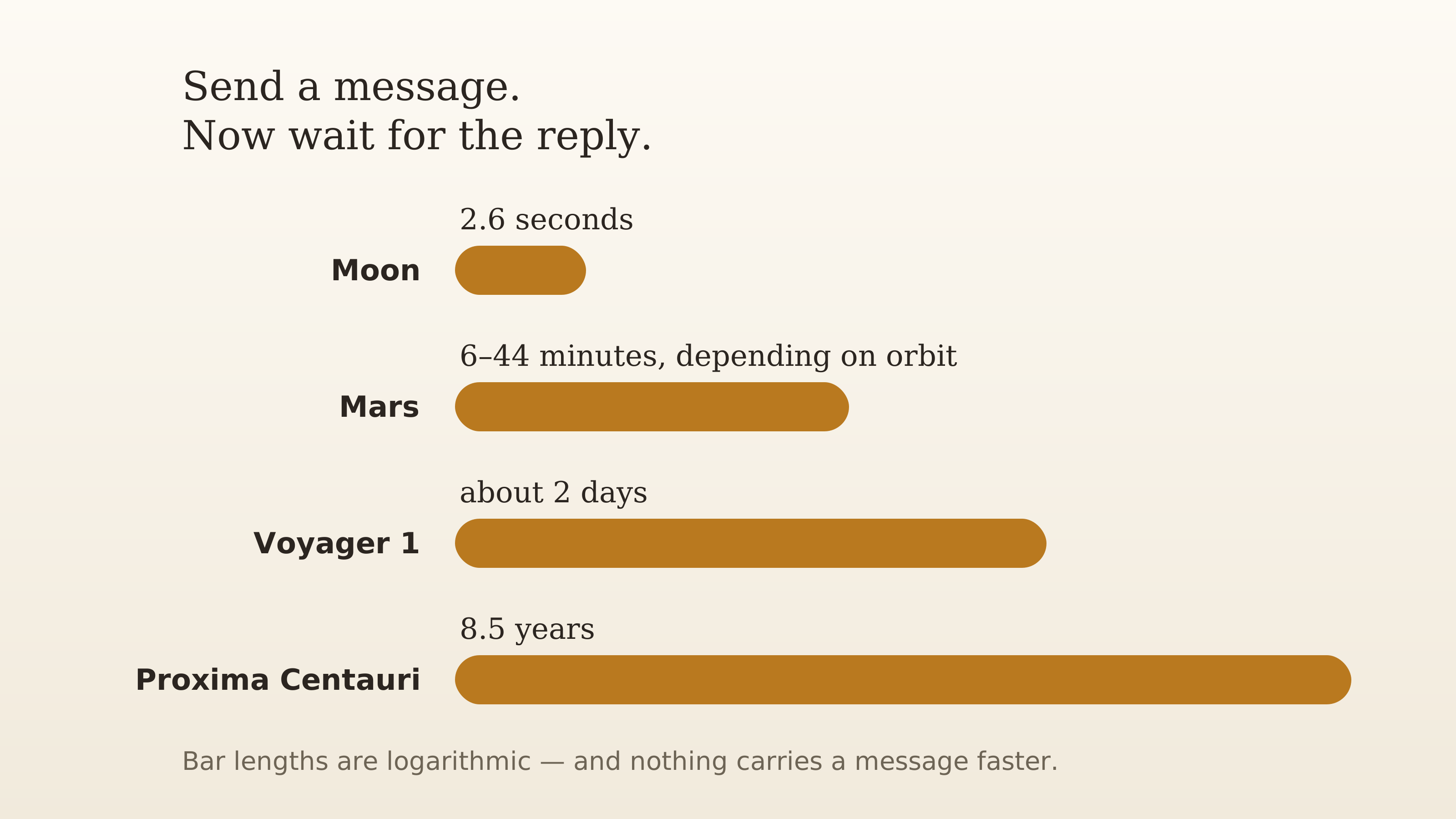
Nothing carries information faster than light. Across empty space, radio and visible light are both electromagnetic waves, just at different frequencies, and both travel at the same vacuum speed. So if I want to know what is happening on Mars right now, I cannot check instantly. Depending on where the planets are, a reply takes roughly 6 to 44 minutes.[3]
Send one to Voyager and NASA waits two days to find out whether the command even worked. Send one to the nearest star and you are waiting eight and a half years for an answer.
So what does "right now, over there" actually mean?
The delay by itself only means we see distant things as they were. Relativity adds the stranger part: observers moving relative to one another can disagree about which distant events happened at the same time. You can define a distant "now" within a chosen frame of reference, but there is no single, observer-independent "now" that every frame shares.[4]
If the Sun magically disappeared this second, Earth would continue moving as before for another eight minutes before either the light or the change in gravity reached us.
I had always assumed "now" was a thing everyone shared and we were just bad at communicating across it. Turns out the sharing part was the assumption.
Two clocks, both perfect, and they disagree
This is where I properly lost the thread.
Two clocks. Perfect ones, no defects, no tricks. One stays here, one goes on a fast trip and comes back.
They will not agree.
Not "one broke." Not "one ran badly." Both were perfect the entire time. They just disagree about how much time happened.
My first reaction was that one of them must be wrong. That is the trap. Neither is wrong.
While the fast one is traveling, nothing feels strange to whoever is holding it. Their heartbeat is normal. Their coffee takes the usual few minutes. Their thoughts run at their usual speed. Same for the one who stayed. Everybody's own clock always feels completely ordinary.
The disagreement only shows up when they come back and compare.
Me: so one of them experienced time slower.
Also me: no. Both experienced it normally. They just took different amounts of it.
That is the reframing that finally landed. Time is not a river everyone is floating in at the same rate. It is more like distance on a road trip.
Two people drive from the same start to the same end. One goes direct, one takes the scenic route. Their odometers read differently at the finish. Nobody is confused by this. Nobody says one car was broken. They took different paths, so they racked up different distances.
Clocks work the same way. Fifty years on one path. Ten on the other. Same start, same finish, different routes.
Different routes through what, though. This is where the word spacetime earns its keep. It is not space with a clock bolted on. Space and time form one geometry. A route is not just where you went — it is where and when, together. The elapsed time on your clock, called proper time, is the spacetime interval along that path.
One thing does flip, though, and it is the part that still feels strange to me. In flat spacetime, between the same two events, an inertial clock records the most proper time. A traveler who turns around and reunites with it records less. Come back, and you are younger than the person who stayed on that inertial path.[5]
And this is not philosophy
I want to be careful here, because at this point it all starts sounding like a thought experiment you can nod at and then ignore.
You cannot ignore it. Your phone depends on it.
GPS satellites carry atomic clocks, and those clocks do not keep the same time as the ones down here. Being higher up in weaker gravity runs them about 45 microseconds a day fast. Moving fast in orbit runs them about 7 microseconds a day slow. Net result, they gain roughly 38 microseconds every day.
38 microseconds sounds like nothing at all. But light travels about 11 kilometers in that time, and GPS works by timing light. Skip the correction and the ranging error grows by roughly 11 kilometers a day, making the navigation solution rapidly useless.[6]
Navigation would be useless before lunch.
So this is not a curiosity somebody worked out on a chalkboard. It is a correction engineers have to apply, every day, or the system falls apart. That was the moment it stopped being a fun idea for me and started being a fact about the world.
Gravity is not a rope
I grew up with the picture of gravity as pulling. Earth has some invisible grip on you, the Sun has a grip on Earth, everything is tugging on everything.
Einstein's idea is stranger and, once it clicks, simpler. For an object in free fall, gravity is not an ordinary pulling force.
Every explanation shows you a bowling ball on a stretched rubber sheet, and I have to admit that picture always bothered me. A sheet sags because gravity pulls it down — so it explains gravity by quietly assuming gravity. It also sits in a room, which makes it feel like spacetime is an object placed inside somewhere else. It is not. There is no room it is sitting in.
The version that finally worked for me has no sheet in it at all.
Put two people on the equator, standing some distance apart, both facing due north. Both start walking perfectly straight. Neither ever turns.
They meet at the north pole.
If you only watched the two of them and never saw the globe, you would swear something was pulling them toward each other. No sideways force does that. There is a shape, and going straight through a curved shape can make paths converge.
That is the geometric heart of gravity. Mass-energy shapes spacetime, and an object in free fall follows the straightest path that geometry allows.
The part nobody told me
This is the piece that actually made it click, and I am a little annoyed nobody leads with it.
When people say gravity bends space, they are leaving out half of it — and it is the half that matters. It bends time too.
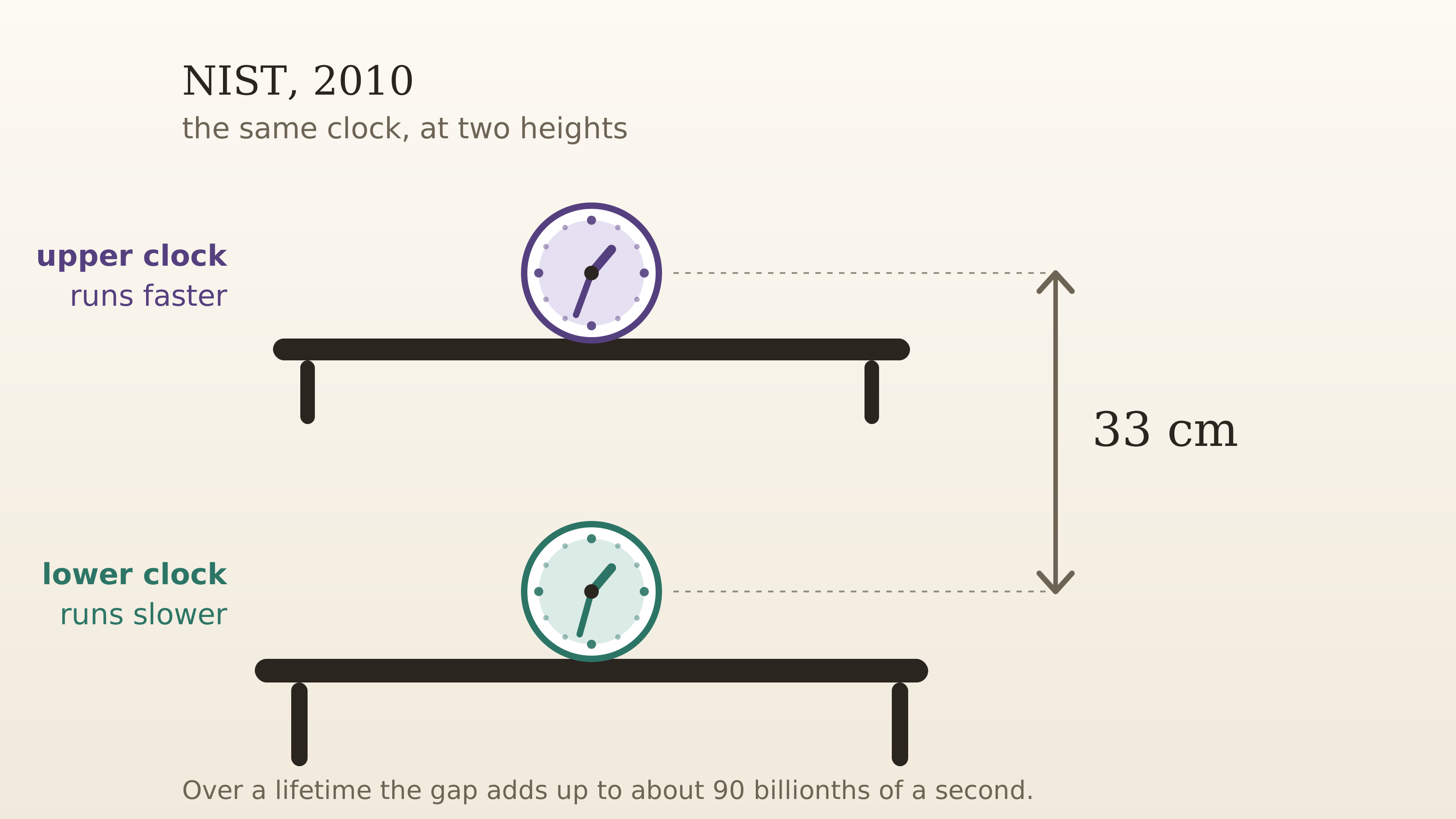
Compared with a stationary clock higher in Earth's gravitational field, a stationary clock lower down accumulates slightly less time. In 2010, NIST measured this with two clocks separated by 33 centimeters of height — about the difference between a shelf and a table. Over a 79-year lifetime the gap would add up to roughly 90 billionths of a second.[7]
Tiny. Also real.
Think of a shopping cart with one sticky wheel. You push it straight, but the slower side covers less ground, so the cart veers toward it. Near Earth, clocks lower down accumulate slightly less time than clocks higher up. Spacetime does not literally have a bad wheel, and that clock-rate difference is not a force by itself. But the cart gives you a way to picture the geometry: paths that begin straight can bend toward the side where time accumulates more slowly.
Let go of a pen and, once your hand stops supporting it, no ordinary force pushes it downward. It follows a geodesic — the straightest path available through curved spacetime. Its fall and the different clock rates above and below it are related consequences of that same geometry, rather than one directly causing the other.
I read that sentence about six times.
And "empty" space is not nothing
This is the part there is no clean answer for.
If spacetime geometry bends and changes how clocks compare — what, if anything, is it made of?
General relativity does not model spacetime as atoms, particles, or any material in the usual sense. It models gravity as dynamic geometry.
That geometry has structure. It curves in response to mass-energy, changes how clocks compare, expands with the universe, and supports waves even through vacuum.
In September 2015 two black holes collided about 1.3 billion light-years away, and the ripple from that collision traveled all that distance and changed the separation of LIGO's mirrors by roughly a thousandth the width of a proton. We had built something sensitive enough to notice.[8]
Not a material being pushed around, but geometry changing as a wave passes.
We can describe that geometry beautifully. Our equations are accurate enough to route spacecraft and catch black hole collisions. What spacetime ultimately is, especially at the quantum level, remains an open question.
Where I landed
There is a line that summarizes the whole thing, and after a night of this it finally means something to me:
Mass-energy tells spacetime how to curve. Curved spacetime tells matter how to move.
But the piece I actually keep thinking about is the smaller one.
There is no universal clock. Nothing is ticking away in the background keeping the schedule for everyone. Time is not one big thing we are all moving through together.
For a massive observer, elapsed time is what a clock records along its own timelike path.
Yours is yours. Mine is mine. They mostly agree because we mostly move alike and remain at nearly the same gravitational potential. Move differently, or spend time at different potentials, and they quietly stop agreeing.
I did not find a final answer to "what is time" last night. Physics tells us extraordinarily well how time is measured and how it behaves, but not what it ultimately is.
A total and complete mind fudge is what it is.
Sources and further reading
- NASA Science: Voyager 1 — mission history, distance, and outward speed.
- NASA Science: Where are Voyager 1 and 2 now? — the one-light-day milestone.
- NASA Science: How communications reach Perseverance — the varying 3-to-22-minute one-way light time to Mars.
- Einstein Online: The definition of “now” — synchronization and the relativity of simultaneity.
- Einstein Online: The case of the travelling twins — elapsed time along different paths.
- NASA: Relativistic effects in GPS — clock-rate offsets and range error.
- NIST: Relativity at a personal scale — the 33-centimeter clock comparison.
- LIGO Scientific Collaboration: GW150914 — the first detected black-hole merger signal.