Years ago I came home from a bad tournament and did what you do after a bad tournament — dropped onto the couch and sulked. Nervous the whole night, hands not cooperating, missing balls I make without thinking. My wife watched this for a while and finally asked why I even play pool.
So I told her. How precise you have to be. How a tiny change in the cue turns into a completely different result. How when a shot you saw in your head actually plays out on the table, there is nothing quite like it.
She let me finish and asked, "So why do you care if you lose?"
Danggggggggg.
I had nothing. Because I did not care — not really. My reason for playing had nothing to do with the score, and I had just spent an entire tournament tense about the one thing that was not the point. Once I stopped defending the wrong thing, tournaments got a lot easier.
But the question did not stay at the pool table.
The Question Followed Me Around
It started showing up everywhere. Why am I helping this person — is it because I want something back later, or because I want to help, or just because they need help right now and that is enough? Why am I taking this on at work? Why does this thing bother me more than it should?
After a while I got curious about whether this was actually a thing or just something I had stumbled into. That is when I found Start with Why by Simon Sinek. It turned out to be less about self-reflection and more about how organizations and leaders work — but the mechanics were the same as what my wife had done to me in about nine seconds.
The Golden Circle
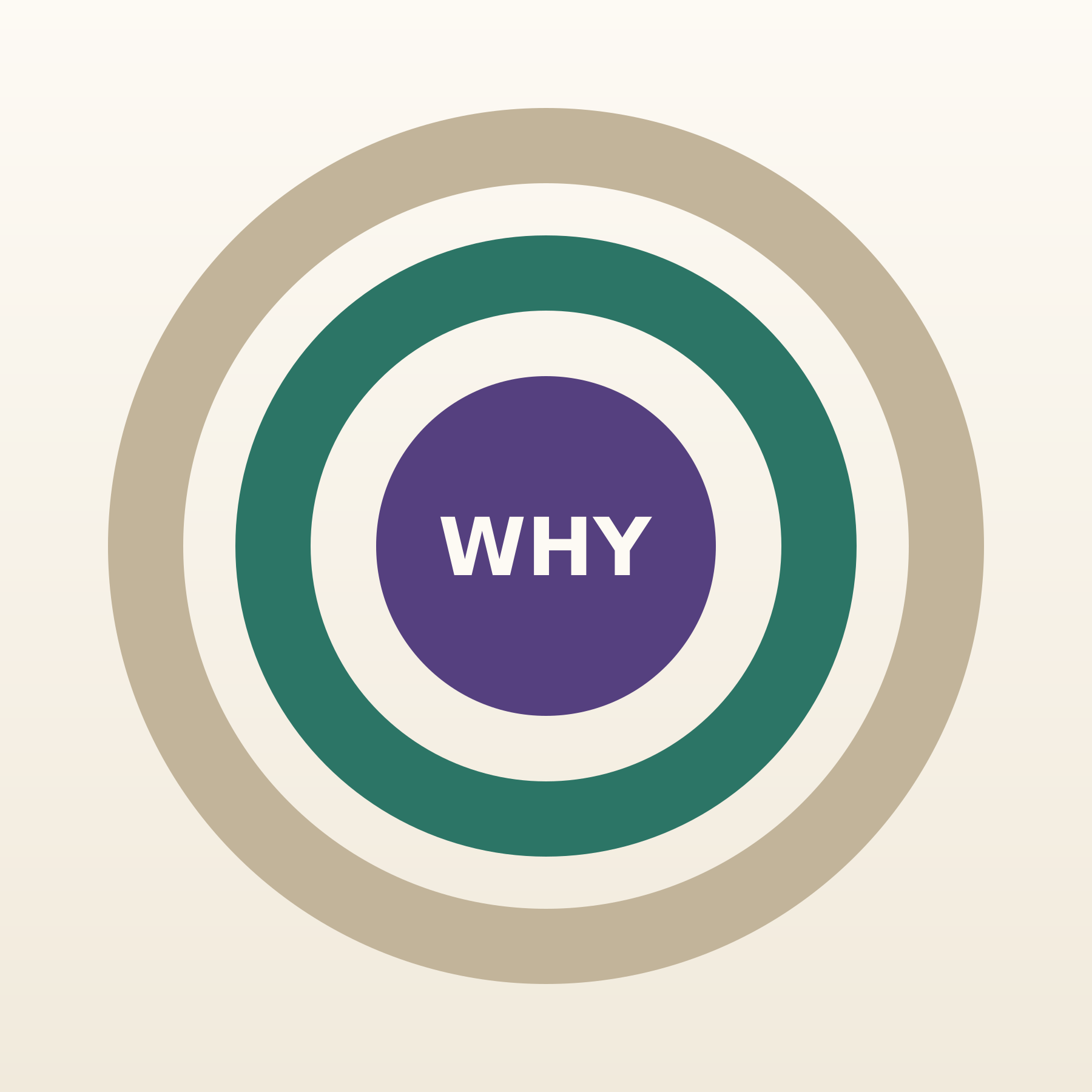
Picture a bullseye. Three rings.
- WHY in the center
- HOW in the middle ring
- WHAT on the outside
Everyone knows what they do. Some people and some companies know how they do what they do. Very few can clearly say why they do it.
And "to make money" does not count. That is a result. The question is what the purpose is — why the thing exists at all.
Watch how most companies sell. They start with what they do, then move to how they do it better than everyone else, and hope you care by the end. It is the bullseye from the outside in. It is also why so much of it sounds identical.
None of this means the WHATs do not matter. They matter a lot — they are the tangible proof that the why is real. But the why has to come first, because it is what gives everything else context. What should be evidence for why, not a substitute for it.
Apple, Said Both Ways
Sinek writes Apple's pitch twice, changing nothing but the order. First from the outside ring:
We make great computers. They're beautifully designed, simple to use and user friendly. Wanna buy one?
Swap in any other brand and that still works, which is the tell. Now from the center:
Everything we do, we believe in challenging the status quo. We believe in thinking differently. The way we challenge the status quo is by making our products beautifully designed, simple to use and user friendly. And we happen to make great computers. Wanna buy one?
Same facts, same products. But the belief comes first, so the products land as evidence instead of as the argument.
You Cannot Argue Someone into Trusting You
This was the part that stuck with me most.
You cannot convince someone that you have value, the same way you cannot convince someone to trust you. Trust is not won by argument. It gets earned when you demonstrate that you believe what they believe.
Sinek breaks it into three pieces that have to line up:
- Why is the belief
- Hows are the actions you take to realize that belief
- Whats are the results of those actions
When all three are in balance, trust gets built and value is perceived. When they are not — when the stated belief and the actual behavior point in different directions — people feel it long before they can explain it.
Which leads to a related idea: the goal of a business is not to do business with everyone who needs what you have. It is to focus on the people who believe what you believe. When you lead with why, the people who share that belief come to you for personal reasons. It is the shared values that tip the system, not the spec sheet.
Values Have to Be Verbs
Almost every company has a values page. Integrity. Innovation. Excellence. Teamwork.
Nobody has ever made a decision using that page.
Sinek's fix is simple: for values and guiding principles to actually work, they have to be verbs. Not "integrity" but always do the right thing. Not "innovation" but look at the problem from a different angle.
One of those is a noun on a wall. The other one tells you what to do on a Tuesday afternoon when something is ambiguous.
Gut Feel Does Not Scale
Here is the practical case for all of this.
A gut decision can only be made by one person. That works fine when the company is small enough that the founder is in every room. But at some point success requires a lot of people to make decisions that feel right, and the founder cannot be in all of those rooms.
Putting the why into words is what makes that possible. It gives everyone the emotional context behind decisions, which is a much sturdier thing to hand someone than "I think this is the right call." With a clearly stated why, anyone in the organization can make a decision as accurately as the founder would have.
A why is a decision filter. That is the whole utility of it.
There is also a nice pairing in the book: those who know why need those who know how. The visionary and the operator are not competing roles. A why without someone who can build is just a nice sentiment.
What Happens When the Why Walks Out
This section is the one I keep thinking about in a work context.
When the person who personifies the why leaves without ever clearly articulating why the company was founded in the first place, they leave no cause behind for anyone to lead. The successor inherits a what, not a why.
So the new leader does one of two things. They focus attention on growing the what and pay little attention to the why. Or they implement their own vision without considering the cause that got most people to show up in the first place.
Either way the leader ends up working against the culture instead of leading it or building on it. Sinek is blunt about where that goes: diminished morale, mass exodus, poor performance, and a slow steady slide into mistrust and everyone for themselves.
You have probably watched some version of this happen. It rarely looks like a single dramatic decision. It looks like a place slowly forgetting what it was for.
Achievement and Success Are Not the Same Thing
The line I have held onto:
Achievement comes when you pursue and attain what you want. Success comes when you are clear in your pursuit of why you want it.
Achievement is driven by tangible things — the trophy, the title, the number. Success sits somewhere deeper, in a part of the brain where we do not really have the language to describe what we feel.
Which brings me back to the couch. I had been chasing achievement at a game I started playing for something else entirely, and I never noticed the swap until my wife asked me the question directly.
The book gave me a vocabulary for something I had already run into by accident. And the useful part is that the question scales down to almost anything. Why am I doing this? Why do I care about this outcome? Is that reason actually mine?
Most of the time the answer is simple and a little uncomfortable. That is usually a sign you asked the right question.
You will defend the wrong thing for years if you never stop to ask why you were there.